
















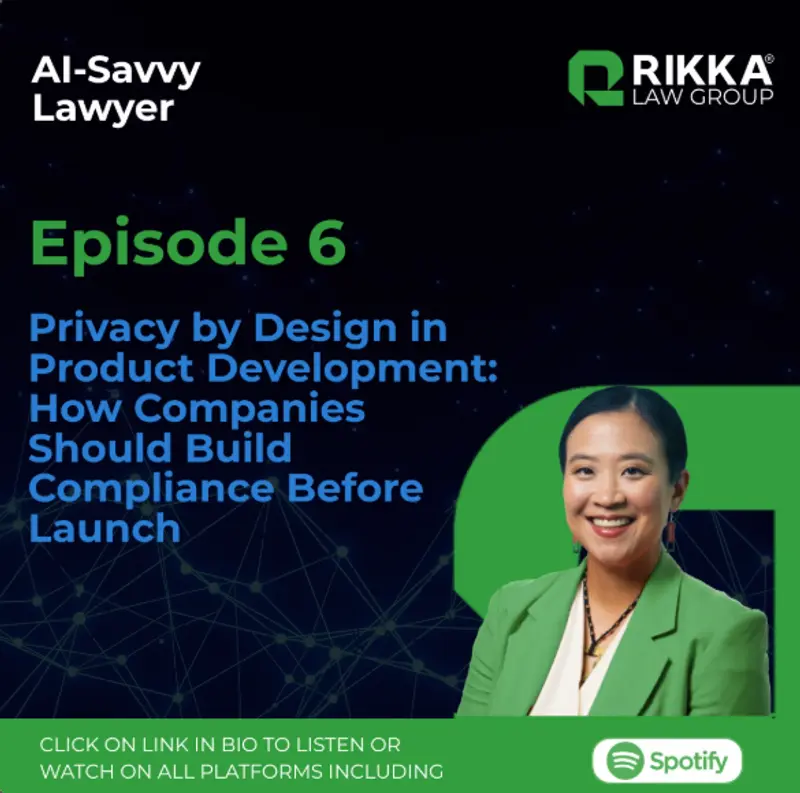
Privacy by Design in Product Development: How Companies Should Build Compliance Before Launch
Charlyn Ho explains what companies need in place before employees start using generative AI, from the bare minimum every AI policy should include to the risks to confidential data, patents and accuracy.
What Companies Need Before Implementing Generative AI Tools
Topics covered
- Why letting employees use generative AI without a formal policy is risky
- How free consumer AI tools and personal accounts create legal and operational concerns
- What every internal AI policy should include at a minimum
- How requirements change by industry, using healthcare and HIPAA as the example
- The legal and reputational risks when company data is exposed through AI
- How generative AI can put intellectual property at risk, including patent rights
- Accuracy and accountability when relying on AI-generated outputs
- The role legal teams should play in creating AI policies
- How often AI policies should be reviewed
- The legal and ethical challenges of AI agents
- What separates strategic AI adopters from companies adopting AI without structure
Key takeaways
- Without a policy, confidential information is at risk. Employees without guidelines may share confidential information, including trade secrets, through tools like ChatGPT. That information has value precisely because it’s kept secret.
- The version and the account matter. Free consumer versions of AI tools often let the provider train on what employees enter, and personal accounts keep the employer from seeing what was shared. Companies should set guidelines for using enterprise versions, or versions with the security protections they need.
- Start with the bare minimum: no tools that train on your data. At a minimum, an AI policy should prohibit tools that allow company data to be used for model training. Beyond that, it should fit the company’s industry and maturity. In healthcare, for example, the policy has to account for HIPAA and state privacy laws.
- Exposed data can cost more than a fine. Companies may face civil penalties from regulators, lawsuits from affected individuals and serious reputational harm. Data shared with an AI provider could also be used to train its models and surface in outputs for other customers, including competitors.
- Uploading an invention can put a patent at risk. Putting invention designs into a consumer-grade AI tool can jeopardize patentability, because public disclosure can affect the ability to patent.
- Verify anything with a legal consequence. Generative AI can produce polished content that’s still wrong. Policies should require human verification of AI outputs, especially for anything with legal implications.
- A policy needs training to work. Legal should be a major stakeholder, but not the only owner, working with technology and cybersecurity teams. Training helps employees understand the policy instead of just signing it.
- Review the policy as AI changes. There’s no set timeline, because the technology moves so fast. New capabilities such as AI agents, which can act on their own, need to be built into the policy as they appear.
- The law on AI agents is still developing. Principal-agent law suggests a company could be responsible for what its AI agent does. Accountability gets harder to settle when several companies are involved in building and deploying the agent.
- Structure is the advantage. In Charlyn’s view, the companies that combine AI adoption with strong governance are the ones best positioned to thrive.
Resources mentioned
- The AI-Savvy Lawyer by Charlyn Ho. Get the book on Amazon
- HIPAA and state-level healthcare privacy laws
- Principal-agent law, the general legal concept of a principal’s responsibility for its agent’s actions
- AI tools discussed: ChatGPT
Favorite quote
“A policy by itself, sitting in a drawer, a digital drawer, so to speak, really does no good unless people actually understand it.”
Charlyn Ho, Founder, Rikka Law Group