
















Federal Privacy on the Horizon: What the SECURE Data Act Could Mean for Businesses

What the SECURE Data Act Could Mean for Businesses
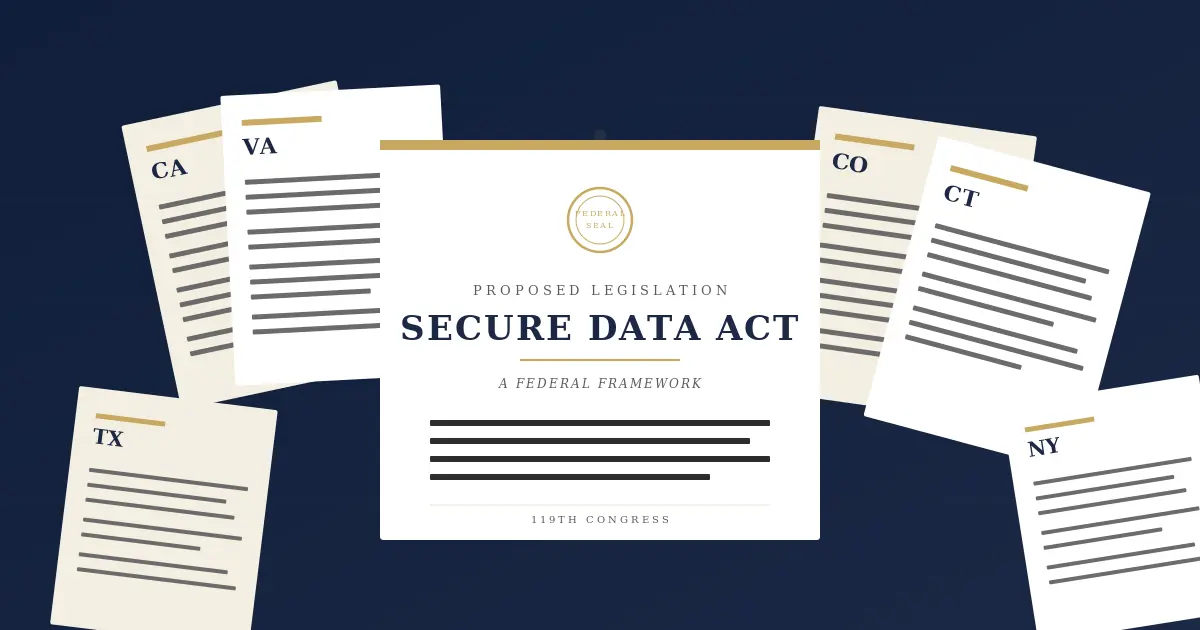
Recently, House Republicans introduced the proposed SECURE Data Act. The bill signals that a comprehensive federal privacy framework may be getting closer to reality, but its impact is far from settled. [1]
For businesses, the bill could change how privacy compliance works in the United States. A single national standard could reduce today’s patchwork of state-by-state requirements.
At the same time, the Act could introduce new baseline requirements. Companies may need to adjust privacy programs they already have in place.
Whether the Act reduces compliance costs or simply reshapes them will depend on several factors. These include its preemption and enforcement provisions, as well as how much it ultimately differs from existing state privacy laws.
Passage is also far from certain. The bill is partisan rather than bipartisan, faces a 60-vote threshold in the Senate, and follows several federal privacy proposals that have stalled in recent Congresses. [2]
Core Consumer Rights Under the Act
At a high level, the SECURE Data Act follows a model that is already familiar from state privacy laws and international frameworks.
The Act would establish core consumer rights, along with obligations for businesses that collect and use personal data.
These rights would include the ability to:
- Access personal information
- Correct personal information
- Delete personal information
- Port personal information
- Opt out of certain uses of personal information
- Opt out of targeted advertising and certain data sales
For companies, this could mean less need to build an entirely new compliance program.
Instead, many businesses may need to harmonize and scale programs they already have under laws such as the California Consumer Privacy Act.
However, the Act could still require significant changes in areas such as:
- Sensitive data handling
- Contracting
- Internal privacy governance
How Businesses Can Prepare
Organizations should start thinking less about whether a federal privacy law will arrive and more about how they would manage a shift from fragmented state requirements to a single federal baseline.
A good starting point is to evaluate whether existing privacy programs can work across different jurisdictions.
Some programs may be heavily tailored to specific state laws, such as California’s. If a federal standard replaces some of those requirements, companies may need to simplify or restructure their existing processes.
Businesses should also review how their current systems would work under a uniform set of obligations.
This includes reviewing:
- Data mapping
- Consent flows
- Vendor contracts
- Opt-out processes
- Sensitive data practices
- Data broker disclosures
Companies should also consider whether the Act could introduce requirements that do not closely match existing state laws.
If so, compliance may require more than simply consolidating current practices. Companies may need to update their privacy governance structures as well.
Why Flexibility Will Still Matter
Even if the SECURE Data Act introduces broad federal preemption, companies should be cautious about assuming that privacy compliance will become completely uniform.
State regulators may continue to shape the privacy landscape through enforcement priorities.
Future amendments or sector-specific laws could also introduce new requirements and add complexity over time.
For that reason, businesses should focus on building privacy programs that can adapt to changing requirements.
A resilient privacy program may include:
- Scalable data governance infrastructure
- Flexible consent and preference management systems
- Contracting frameworks that can accommodate federal requirements
- Processes that can adapt to remaining or future state requirements
The goal should not be to build a program around the exact language of one bill. Instead, companies should create a framework that can adapt as privacy requirements evolve.
What Businesses Should Take Away
The SECURE Data Act reflects a continued push toward a national privacy standard in the United States.
That does not necessarily mean privacy compliance will become simpler.
A single federal framework could be valuable for companies managing compliance across multiple states. However, the reality may be more nuanced: businesses could see a reshaping of privacy obligations rather than a complete reduction in them.
For businesses, the takeaway is clear: do not wait for certainty before preparing.
Companies can start by building privacy programs that are:
- Adaptable to changing requirements
- Scalable across jurisdictions
- Flexible enough to meet a common federal baseline while responding to future state requirements
Sources
[1] HIPAA Journal, “House Republicans Introduce Federal Data Privacy Legislation”
[2] Mayer Brown, “House Republicans Introduce SECURE Data Act”